
Should you use cardboard boxes or reusable moving crates? That is usually one of the first questions people ask after the move date is set. You can use either method to move your stuff from one place to another. Still, each choice tends to match different budgets, timelines, and kinds of items. To pick well, look at a few things. How much are you moving? How far you need to travel. What you plan to pack. Also check if reusable crates are offered in your area. This guide breaks down the common differences between moving boxes Auckland families often use and reusable crates. Then you can decide what works for your move, whether you plan to do the work yourself or you will use a crew, like Auckland Kiwi Movers.
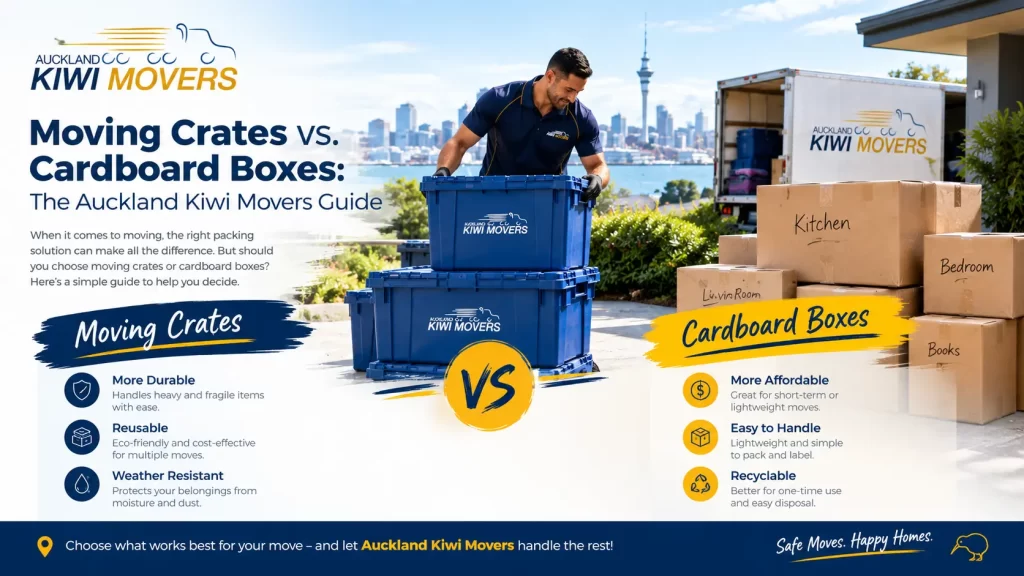
Quick Answer: Are moving crates better than cardboard boxes?
Not always. When you move heavy loads, crates tend to hold up better and stack neatly. They also work well if you plan to move again or if you can reuse the containers. Cardboard boxes cost less at the start. They are also easy to find and simple to get rid of later. That makes them a better fit for smaller moves or situations where you only need boxes one time. Pick what fits your budget and your schedule. Think about what you are packing too. Also check if you can actually get reusable crates where you live.
Moving Crates vs. Cardboard Boxes: What’s the Difference?
Reusable plastic moving crates are hard storage boxes made to fit together or to stack. They are built for repeated use, even if you move more than once. Cardboard moving boxes are usually meant for one trip, or for only a few uses. They are made from corrugated paperboard. You might buy them flat and unfold them later, get them used, or pick them up at a moving shop.
| Feature | Moving Crates | Cardboard Boxes |
| Durability | Generally more durable, depending on crate design | Varies with cardboard weight and quality |
| Reusability | Designed for repeated use over many moves | Limited reuse; weakens with handling |
| Cost | Often rented or subscribed; no ongoing storage needed | Lower upfront cost, especially if sourced free |
| Stacking | Uniform sizing usually stacks more securely | Depends on matching box sizes |
| Moisture resistance | Generally better resistance to damp conditions | Can weaken or collapse if exposed to moisture |
| Convenience | Delivered and collected as a set, less assembly | Requires assembly, taping and sourcing |
| Availability | Depends on local rental or supply services | Widely available from retailers and supermarkets |
| Storage after move | Returned to provider (if rented) or stored if owned | Can be flattened, kept, or recycled |
| Environmental considerations | Lower waste per move if reused many times | Recyclable, but often used only once or twice |
Neither option wins outright; the table above is a starting point, not a verdict.
Are Moving Crates Better Than Cardboard Boxes?
Neither container type is automatically the right choice for every move. It comes down to what you’re moving, how often you move, and what matters most to you: cost, durability, or convenience.
Crates tend to work well when:
- You’re moving frequently, such as between rentals
- You want a consistent, organised packing system
- Your move involves a short-term relocation with a fixed collection date
- Moisture protection matters, such as during Auckland’s wetter months
- Items will be handled multiple times before reaching their final spot
Cardboard boxes tend to work well when:
- You want the lowest possible upfront cost
- You need boxes quickly and don’t have time to arrange rental
- You’d like to keep some boxes afterwards for storage
- You want to recycle everything once the move is done
- You need a range of box sizes for odd-shaped or mismatched items
- It’s a smaller move, such as a studio or one-bedroom apartment
Advantages of Using Moving Crates
Depending on the crate design, reusable moving crates can offer:
- Durability — rigid plastic construction generally holds up better under weight than cardboard
- Reusable design — the same crates can support many moves over their lifespan
- Stackability — uniform sizing often stacks more securely in a truck or storage unit
- Moisture resistance — some reusable crates handle damp conditions better than cardboard, useful during Auckland’s rainier spells
- Easier handling — built-in handles on many crate designs can make lifting more comfortable
- Reduced need for tape — many crates use lids rather than tape, which speeds up packing and unpacking
- Consistency in size — a uniform crate size can simplify planning truck space and labelling
- Suitability for repeated use — useful if you expect to move again within a few years
Not all crates are built the same, so it’s worth checking what’s actually on offer before assuming every feature applies.
Advantages of Cardboard Moving Boxes
Cardboard boxes remain a practical option for many Auckland movers, particularly because of:
- Affordability — generally the cheapest packing option, especially if sourced second-hand
- Wide availability — available from hardware stores, supermarkets, and moving supplies Auckland retailers
- Different sizes — easy to match box size to item type, from small book boxes to larger linen boxes
- Easy labelling — cardboard takes pen, marker, or printed labels well
- Convenient for one-off moves — no need to arrange collection or return
- Recyclable options — many councils accept flattened cardboard for kerbside recycling
- Easy storage before moving day — flat-packed boxes take up little space while you’re still packing
Cardboard quality varies significantly between suppliers, so it’s worth choosing boxes rated for the weight of their contents; a box built for books will hold up differently to one meant for pillows.
Moving Crates vs Cardboard Boxes: Cost Comparison
It is hard to compare the price of crates and cardboard. There is no simple per-box number that tells you the whole story. The total cost changes with a few factors. If you buy cardboard boxes, you typically pay for each box one time. On top of that, you may need tape and labels. You might also add extra protection like paper or bubble wrap. You can also lower the cost by reusing boxes. Some people get them from friends or family. Others use local buy and sell groups.
Reusable crates are typically obtained through a rental or subscription model, where cost is usually based on the number of crates, the rental period, and whether delivery and collection are included.
Overall cost for either option tends to depend on:
- The number of containers required
- Container size and load capacity
- Whether you’re buying, renting, or reusing
- Delivery and collection logistics
- Moving distance and how long items are in transit
- Additional packing materials such as tape, wrap, or padding
There is no one “lowest price” option for every home. If you choose cardboard or crates, the total cost for moving boxes across Auckland will depend on the amount you need moved and what you can get locally. If you are booking a team of professional movers that Auckland residents often use, it helps to bring up packing materials when you talk about the quote.
Which Option Protects Your Belongings Better?
The container is only one part of protecting your belongings — how items are packed inside it matters just as much.
- Clothing and linens — generally low risk in either boxes or crates
- Books — benefit from smaller, sturdier containers to avoid overloading larger boxes
- Kitchen items — need padding regardless of container type
- Glassware and fragile items — require bubble wrap or paper padding, individually wrapped, in either boxes or crates
- Electronics — benefit from original packaging where possible, plus padding against movement
- Documents — best kept in a labelled, easily accessible box or crate, separate from general items
- Toys — generally low risk, though loose or sharp-edged items should be padded
- Decorative or fragile items — need extra wrapping and clear labelling regardless of container choice
Crates and cardboard boxes do not, by themselves, ensure your items will be safe. What matters more is getting the size right for what you are shipping. You also need to avoid packing too tightly or overloading. Use padding or other protective material that fits the item. Finally, load everything into the truck with care, not just fast and rough. The container type is only part of the picture.
Moving Crates vs Cardboard Boxes for an Auckland Apartment Move
Apartment moves bring their own logistics, and these can influence which packing option feels more practical.
- Lift access — smaller, uniform crates can be easier to manage in a lift than an oversized cardboard box.
- Carrying distance — long corridors or multiple trips favour containers with handles.
- Stairs — walk-up apartments benefit from containers that aren’t overloaded, regardless of type
- Loading areas — some Auckland apartment buildings have limited loading zones or time restrictions for moving trucks.
- Limited parking — CBD and inner-city apartment moves often need to work around restricted parking and traffic timing.
- Building rules — some buildings have specific requirements around lift bookings or moving hours, so it’s worth checking with building management in advance
- Compact storage — flat-packed cardboard can be easier to store in a small apartment before moving day than bulky crates
- Labelling boxes and crates — clear labelling matters more in apartment moves, where multiple trips through shared spaces increase the chance of items being misplaced
Crates that are all the same size can help when you make several trips during an apartment move. Cardboard boxes are usually simpler to find quickly. Once you are moved in, you can get rid of them without much trouble. Each apartment building can have its own rules for moving items in. So it helps to ask your building manager before moving day.
Which Is More Environmentally Friendly?
There’s no simple answer here — the environmental impact of both options depends on how they’re used, not just what they’re made from.
Reusable crates can reduce waste over time, but only if they’re actually reused many times across multiple moves. A crate manufactured, used once, and left in storage indefinitely doesn’t offer much of an environmental advantage over cardboard.
Cardboard is widely recyclable through kerbside collection in most parts of New Zealand, and boxes can often be reused a few times before they lose structural strength. However, cardboard production and disposal still carry a manufacturing and waste footprint.
Other factors that affect the overall environmental impact include:
- How the crates are transported for delivery and collection
- Whether cardboard boxes are recycled or sent to landfill after use
- The manufacturing footprint of both plastic crates and cardboard
- How many times a crate is realistically reused before being retired
It’s inaccurate to say plastic crates are always more environmentally friendly; the real impact depends on reuse rates, transport, and what happens to each option once the move is finished.
How Many Moving Boxes or Crates Do You Need?
Box and crate requirements vary considerably between households, and there’s no universal number that applies to everyone. Factors that influence how many containers you’ll need include:
- Number of bedrooms and overall floor space
- Household size and number of people packing
- General volume of belongings, including seasonal items
- Kitchen contents, including appliances, crockery and pantry goods
- Book collections, which are heavier and often need smaller boxes
- Wardrobe size and clothing volume
- Garage, shed or storage area contents
- Whether you’re decluttering before the move
A practical approach is to pack room by room, starting with items you use least often, and adjust as you go rather than relying on a fixed formula for how many moving boxes Auckland moves typically need. If you’re arranging a quote with house movers Auckland residents use, giving an accurate description of your belongings will help with planning container numbers and truck size.
What Should You Pack in Boxes and What Should Go in Crates?
| Item Type | Suitable Option | Packing Tip |
| Clothing | Either | Use vacuum bags or soft packing to save space |
| Books | Smaller boxes or crates | Keep boxes small to avoid overloading |
| Kitchenware | Either, with padding | Wrap individually and pack heavier items at the bottom |
| Fragile glassware | Crates preferred where available | Use bubble wrap and avoid overpacking |
| Electronics | Either, ideally original packaging | Pad securely and label “fragile” clearly |
| Documents | Small labelled box or crate | Keep separate and easily accessible on arrival |
| Toys | Either | Group by size and pad sharp edges |
| Pantry items | Sturdy boxes or crates | Seal open packets and avoid overloading |
| Small household items | Either | Group by room to simplify unpacking |
Packing Tips for a Smoother Auckland Moving Day
- Declutter before packing — fewer items means fewer containers and less to carry.
- Label every box or crate — note the room and general contents on at least two sides.
- Keep heavy items in smaller containers — books and tinned goods are easier to carry in smaller boxes.
- Don’t overfill containers — overloaded boxes and crates are more likely to fail or become unsafe to lift.
- Protect fragile belongings — use bubble wrap, paper or padding, not just the container itself.
- Create an essentials box — pack toiletries, chargers, and basic kitchen items separately for your first night.
- Keep important documents separate — ID, contracts, and paperwork should travel with you, not in the truck.
- Keep pathways clear — clear hallways and doorways reduce delays and accidents on moving day.
- Tell your movers about unusually heavy or fragile items — this helps with safe handling and truck loading.
- Prepare apartment or building access in advance — confirm lift bookings, parking and loading zone access if you’re in an Auckland apartment.
When Should You Choose Moving Crates?
Reusable crates tend to make sense when:
- You want containers you can reuse rather than dispose of
- You move fairly often, such as between rental properties
- You prefer uniform stacking for easier truck loading
- Durability matters more than upfront cost
- You have access to a crate rental or supply service in your area
When Are Cardboard Boxes the Better Choice?
Cardboard tends to be the more practical option when:
- It’s a one-off move with no plans to move again soon
- Budget is the main priority
- You have easy access to free or low-cost boxes
- You need a mix of box sizes for varied or oddly shaped items
- You’d like to recycle your packing materials once you’re settled
- You already have suitable boxes on hand
Can Auckland Kiwi Movers Help With Your Move?
Whichever packing option you choose, the logistics of moving day loading, transport and unloading are where professional movers add the most value. Auckland Kiwi Movers can help with the moving process itself, and it’s worth discussing your packing requirements, fragile items, furniture and any access conditions (such as apartment lifts, stairs or parking restrictions) when requesting a quote, so the move can be planned around your specific situation.
Planning a move in Auckland? Contact Auckland Kiwi Movers with your moving date, pickup and delivery details, household size and packing requirements to discuss your move and request a quote.
Moving Crates vs Cardboard Boxes: Final Verdict
There’s no universal winner when it comes to moving boxes; Auckland movers choose between crates and cardboard. The right choice depends on your specific move. Choose reusable crates when durability, repeat use and organised packing are priorities, particularly if you have access to a crate supply service. Choose cardboard boxes when affordability, easy availability and recycling after the move matter most. For some households, a combination of both crates for fragile or heavy items, cardboard for everything else ends up being the most practical approach.
Frequently Asked Questions
Not universally. Crates tend to be more durable and reusable, suiting frequent movers or larger households. Cardboard boxes are cheaper and easier to source, suiting one-off or smaller moves. The best choice depends on your budget, timeframe, and how many belongings you’re packing.
It depends on how you’ll use them. Crates can be worthwhile if you move often, want uniform stacking, or need durable containers for a short-term relocation. For a single move on a tight budget, the cost of renting crates may not offer much advantage over cardboard.
Yes, cardboard boxes are a practical option for most house moves, particularly one-off relocations. Quality varies, so choose boxes rated for the weight of their contents and avoid overfilling them, especially with heavy items like books.
Sourcing free or second-hand cardboard boxes, reusing what you already have, and minimising extra packing materials is typically the lowest-cost approach. Decluttering before packing also reduces the number of containers you need to buy or source.
Either boxes or crates can work for fragile items, as long as they’re padded properly with bubble wrap or paper, sized correctly, and not overloaded. The protective material used inside the container matters more than the container type itself.
This varies widely based on household size, number of bedrooms, and volume of belongings. Rather than relying on a fixed number, pack room by room and adjust as you go, starting with items you use least often.
It depends on reuse. Crates can reduce waste if reused many times across multiple moves, but a crate used only once or twice offers little environmental advantage over recyclable cardboard. Transport and disposal practices also affect the overall impact.
Professional movers can generally assist with the moving process, including handling and transporting your packed items. It’s best to discuss your specific packing materials, fragile items, and access requirements directly when requesting a quote.