
Moving house with difficult access Auckland is all about two questions. The first is where the truck can pull up; the second is how far everything has to walk. On a steep driveway with restricted truck access, the answers dictate the rest of the day.
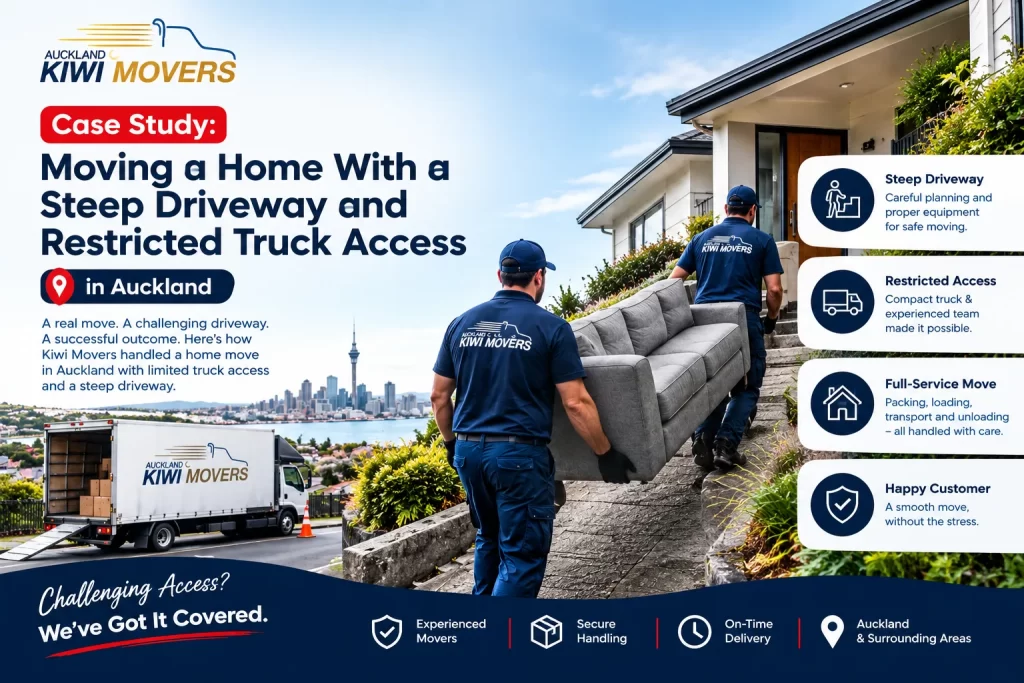
Quick answer: How a steep driveway move works is that access is assessed before the move day; the team then chooses a truck and lay-by that they are happy with and works out where everything has to be carried from, how the job has to be loaded around that extra distance, and how to ensure the safety of both furniture and people during the move. The sooner the homeowner can get photos of the access and the driveway, the better the job can be planned.
This worked example shows how Auckland Kiwi Movers approach steep driveway house moves as well as what a homeowner needs to do to ensure that an Auckland house relocation with restricted access is successful. This is not a case study of a customer’s move but instead shows the planning involved in such a move. The stats relating to the truck used, staff, and time are Auckland Kiwi Movers published guides for the type of job.
Planning snapshot
| Home size | Truck | Crew | Typical time |
| 1 bedroom | 20 m³ | 2 movers | 2–4 hours |
| 2–3 bedrooms | 20–30 m³ | 2 movers | 4–6 hours |
| Large family home (3–5 bedrooms) | 40 m³ | 2 movers, extra mover on request | 6–9 hours |
Typical times are guides, not guarantees. I understand. Stairs, parking distance and access, including a steep driveway, can all add up. Charging is hourly, with a callout fee, a two-hour minimum, and 15-minute increments after the first hour, so extra carrying time can factor in.
The Moving Challenge: A Steep Driveway and Limited Truck Access
This worked example demonstrates how Auckland Kiwi Movers tackle steep driveway house moves as well as what a homeowner should prepare when arranging an Auckland house removal with limited access to the site. Note that this is not a customer’s case but rather a general description of the preparation stage only. The statistics concerning the truck, crew, and time spent are based on Auckland Kiwi Movers’ industry guidelines for similar tasks.
Common moving truck access problems include:
- limited space to maneuver or turn a truck
- a driveway that is too steep or narrow for the truck to navigate in the job
- long carrying distances, especially with large furniture
- steps, tight turns, and narrow passages between the door and the truck
- limited nearby parking when the truck can’t use the driveway
Not all apply to each property, which is why the first step is to research which do apply to yours.
Assessing the Property Before Moving Day
An access survey conducted either in advance during an inspection or by phone is completed before any removal company arrives at your property to size up the job. Movers will need to know about the following things that could be deemed as a challenge when removing furniture from your home:
- the fall, breadth, and texture of the driveway
- whether there is a space to manoeuvre the vehicle
- street parking
- the distance between the property and the nearest loading point
- stairs, walks, doorways, and narrow openings to be negotiated
- the largest and heaviest items such as wardrobes, white goods, and tables.
Auckland Kiwi Movers asks about bedrooms, stairs, driveway, and oversized items when you call for a quote, and figures out access with the customer ahead of time. Our article about how movers deal with long carries and limited parking covers the rest.
Planning the Move Around Access Restrictions
Difficult driveway moving solutions are rarely clever techniques. They are built around a handful of planning decisions:
- Truck choice. Auckland Kiwi Movers operates with 20, 30 and 40 m³ vehicles with 2 movers per truck. The truck size is determined by the customer’s home and access.
- Moving truck positioning. If the crew finds that the driveway is unsafe or inaccessible, the truck can be pulled back to the nearest safe area from which it can load the furniture. This is entirely up to the crew on the day of the move and their assessment of the job.
- Loading order and carry routes. The loading sequence and route should also be carefully planned to avoid double handling and keep the passage clear.
- Time. A longer walking distance adds to the job’s overall time; therefore, you should estimate it when planning the route. You can also request an additional mover if the load is heavy.
- A fallback. Finally, having a contingency plan for the day of the move helps to adapt to changing conditions such as rain or a road closure.
How the Moving Team Managed Furniture and Belongings
Safe furniture handling on a difficult-access job is generally about limiting risks and repetition. Common practice encompasses:
- wrapping the furniture in moving blankets and shrink wrap, as well as padding delicate items, before it leaves the room
- dismantling beds, tables and wardrobes where it aids in navigating doors and corners, then bagging and labelling the hardware
- staging items near the exit to ensure each trip is a controlled load
- keeping clear of boxes, bins and garden furniture in the path
- using trolleys only where the surface and slope permit
The typical hourly rate offered by Auckland Kiwi Movers incorporates the use of moving blankets, shrink wrap, and bubble wrap for fragile items, trolley, bed, table, and wardrobe disassembly and reassembly, and door frame protection. Your furniture items are placed where you want them at your new destination after being taken apart, packed, and moved. For more details on this aspect of our services, check out our furniture moving in Auckland page.
Safety Considerations During a Difficult-Access Move
Careful planning is particularly important where ground conditions, steep gradients, and the size and weight of items to be carried are all factors. The main issues to consider are:
- placing the truck only at positions deemed appropriate by the crew for lifting and lowering items
- clearing away potential tripping hazards from access routes
- assessing heavy or awkward items and sharing the load if/when appropriate
- avoiding unnecessary lifting and carrying by good sequencing
- allowing space for the crew to work
- reviewing the plan if circumstances change and a different approach is necessary
Lifting, carrying, pushing and pulling heavy loads is a recognised cause of injury at work, and WorkSafe NZ publishes manual handling guidance for workplaces. Treat it as background reading, not as a rule for any particular driveway. An assessment of the actual site always comes first.
What a Successful Outcome Looks Like
Because this is a worked example, no customer result is provided. A well-executed steep driveway move typically involves the access arrangement identified on the day of the move being used, the truck being placed at the location the crew determines to be most appropriate, all furniture arriving at the destination in good condition and assembled, and the customer completing a walk-through of all rooms with the crew before they leave. For a report on how access shaped a specific job, read our Auckland CBD apartment move case study.
What Auckland Homeowners Can Take From This Example
Across access-related moving challenges, the troubles that prove most vexing are those that reveal themselves too late. Before requesting a quote, it is important to ask yourself these questions:
- Take photos or a short video of the driveway, entrance, and any steps
- Note narrow sections and limited turning areas
- Estimate the length of the driveway and describe its slope honestly
- Mention stairs and long carrying distances at both addresses
- List bulky or unusually heavy items, such as wardrobes, fridges, pianos, or spa pools
- Check possible loading and parking spots near the property
- Report any access restrictions when requesting a quote
- Ask how the moving company will manage the restrictions
How to Prepare for a Difficult-Access House Move
Good residential relocation planning is practical, and so is being prepared for the day itself. Moving companies in Auckland will have to plan around what they know, so you should:
- Clear the driveway and paths of bins, plants and garden furniture.
- Seal and label boxes by room so that you don’t waste time searching for them. If you’re short of time, we can help you pack.
- Measure large items of furniture against doorways, stairs and corners in both houses.
- Check your insurance. Contents insurance typically doesn’t cover loading and unloading, whereas a mover’s insurance might not cover things your contents insurer does. Auckland Kiwi Movers is insured, and we’re happy to give you more information if you want to know what the coverages are.
- If the new home will not be ready, ask about short-term storage.
Contact difficult access movers in Auckland early if the truck can’t reach the door, the slope worries you, or you have heavy items. If you are comparing house removalists in Auckland, our guide to choosing a mover will list what to ask. For a whole home move, start with our house moving service and published hourly rates for everything.
Frequently Asked Questions
When moving house on a steep driveway, movers usually position the truck at the nearest point the crew judges safe, then carry items along a planned route from the house. The right spot depends on the slope, width, surface, and turning space. Giving photos and driveway details before moving day lets the crew plan the carry and allow enough time.
In most cases, yes. House moving with restricted truck access usually changes the method rather than ruling out the move: the truck may park further away, items may be carried further, and more time may be needed. Telling your movers about narrow driveways, limited turning space, and parking limits at the quote stage helps them prepare.
It can. Longer carries, steep driveways, and stairs add time, and where pricing is hourly, that time may affect the total. Auckland Kiwi Movers charges by the hour with a two-hour minimum, so describing your access honestly helps produce a realistic estimate. Ask how access is reflected in any quote.
Yes. Mention the driveway early, ideally when you request a quote, with its approximate length and width and where a truck could realistically stop. Early detail lets the crew choose a suitable truck, plan the carry, and estimate time realistically, rather than discovering the problem on the day.
Clear walkways, empty drawers where practical, and measure large pieces against doorways, stairs, and tight corners. Tell your movers about heavy or awkward items such as wardrobes, double-door fridges, or pianos in advance, as oversized items may cost extra. The crew can dismantle and wrap furniture.
Share your pickup and drop-off addresses, home size, preferred date, and any large or fragile items. For difficult access, add the driveway slope and width, where a truck could park, the carrying distance, any steps or stairs, and a few photos. Mention access at the destination too, since it can affect the plan.
Planning a move with a steep driveway or limited truck access? Contact Auckland Kiwi Movers to discuss your property’s access requirements and request a moving quote. You can also call 022 400 5991 or 0800 549 149, Monday to Saturday, 7 am to 7 pm.
Final Verdict: Plan the Access Early
A steep driveway and restricted truck access rarely stop a move. They change how it is done: where the truck stops, how far items are carried, how much time to allow, and how carefully the crew works. The deciding factor is how early the access is understood. Share photos and driveway details when you request a quote from Auckland Kiwi Movers, ask how the restrictions will be managed, and the day is far more likely to run to plan.