
Moving out of a standalone house is fairly predictable: back a truck up the driveway, carry everything down a few steps, done. Apartment moves rarely work that way. There’s a lift to book (or not), a building manager to coordinate with, a loading zone that might already be taken, and a corridor a queen bed frame may or may not clear. If you’re moving into or out of an apartment in Auckland CBD or any of the city’s other high-rise pockets, these details usually matter more than the driving distance itself, which is exactly why apartment movers Auckland residents hire tend to plan around access first and volume second.
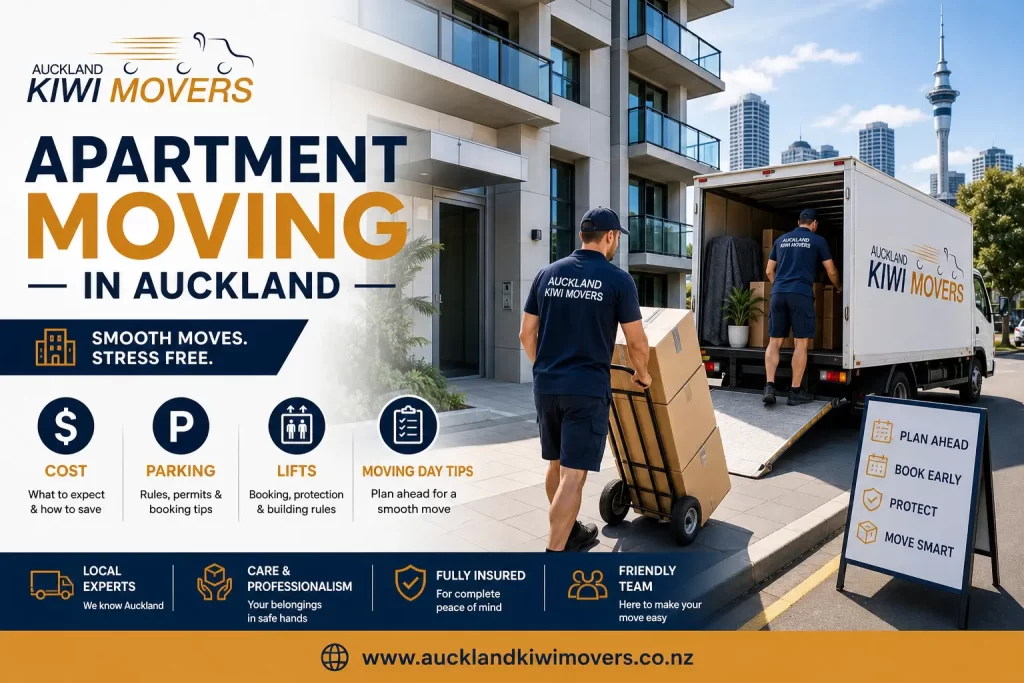
Moving an apartment in Auckland can cost more or less for a few clear reasons. This also covers the things you should handle before the movers show up.
Quick Answer: Apartment move prices in Auckland depend on a few things. For one, the apartment size matters. Also, it changes based on how much furniture you have to move. The distance between the two places plays a role too. The number of movers used and the truck size needed can shift the total as well. Access can cost more. If there is a lift, it is usually easier. If there are lots of stairs, it can add time. Parking near the building also matters. Loading and unloading time is another factor that can change the final price.
How Much Does Apartment Moving Cost in Auckland?
A studio with lift access and a nearby loading zone will typically cost less to move than a three-bedroom apartment with stairs-only access and no close parking.
Rather than publish a fixed price, which wouldn’t reflect the wide range of apartment layouts across the city, it’s more useful to understand the factors that go into a quote.
| Factor | How It Can Affect a Move |
| Apartment size & furniture | More rooms and belongings mean more time, crew, and a larger truck |
| Moving distance | Longer trips between pickup and delivery add to time and fuel costs |
| Number of movers & truck size | Multi-storey or lift-access jobs sometimes need extra crew and a bigger vehicle |
| Lift access & stairs | A working lift can speed things up; stairs-only access adds time and effort |
| Parking & loading distance | A long carry from truck to front door adds time to every trip |
| Building access | Security doors, key fobs, or restricted entry points can slow the process |
| Packing requirements | Full-service packing takes longer than moving pre-packed boxes |
| Loading and unloading time | Narrow corridors or awkward turns extend how long this takes |
Are apartment movers more expensive than house movers? Not necessarily — it depends on access, not property type. Moving can feel faster in a ground-floor flat when the loading dock is right there. A two-storey home with a steep drive can slow things down a lot. Cost usually rises for other reasons. Access issues matter most. For example, there might be no lift. You may have to carry items a long way. Parking could be tight or limited. Stairwells can also be narrow.
Why Apartment Moves in Auckland Can Be More Complicated
A house move is largely about volume and distance. An apartment move adds a layer of logistics: building access (swipe cards, intercoms, security doors), shared lifts that sometimes need booking, limited kerbside parking, loading zones that aren’t always available, narrower corridors and stairwells, shared loading docks, body corporate rules that vary building to building, CBD traffic, and furniture dimensions that don’t always clear apartment-sized doorways.
None of these issues are unusual on their own — the difference is that an apartment move often involves several at once, which is why planning makes a real difference.
Lift Access: What Apartment Movers Need to Know
Do movers need a service lift for an apartment move? Not always — it depends on the building. Some buildings have a dedicated service lift for furniture, deliveries, and larger items, while others only have standard passenger lifts. Depending on the building, using the service lift may be required by management, particularly for larger moves.
Can movers use a passenger lift? In many buildings, yes, especially for smaller apartments without a separate service lift. Some places limit when you can move items, or say you must use a specific lift. In some cases, they ask that padding be put inside the lift to protect it. It helps to ask your building manager ahead of time, so your movers do not get turned away on the day.
Before moving day, double-check a few items. Measure the lift opening, especially for a wardrobe or a mattress. Also confirm the lift can handle the item weight, because older lifts may be lower than you expect. Find out if you must book the lift, and how far ahead. Ask about any time limits for moving. Then ask what the staff wants from you, like your ID, access cards, or a signed form, before movers can use the lift.
If there is no lift that can be used, or if it is not working, the plan changes. Staff might have to carry items up the stairs. That usually takes longer, and for taller buildings it may also require extra people. Ask your building manager whether there’s a backup plan for lift outages.
Apartment Parking and Loading Zones in Auckland
Parking is a frequent problem when you move into an apartment. This is especially true in Auckland CBD, where kerb space is tight. Loading bays are sometimes shared with others, or they have time limits. Some apartment blocks have their own loading area. Other places depend on public loading zones nearby, and those spots can already be taken. Even a small walk from the truck to the front door turns into a lot of effort over many trips. It helps to look up the local parking rules. You can check with the council or ask building staff about what is allowed. If you arrive outside the busiest CBD times, you often get faster loading and unloading.
A good step is to tell your movers this early. Share where the truck can actually stop. Mention how far the items must be carried. Also confirm if there is a loading dock or a usable loading zone. With that, they can set the crew plan and timing with less guesswork.
Building Access and Large Furniture
Sofas, beds, wardrobes, dining tables, fridges, and washing machines are often the hardest to move. Apartment hallways can make it worse. First, look at the door and hall sizes. Check the stairs and the landings. If corners are tight, you may need to tilt the piece or take parts off. Also, confirm the lift size when the item is large. Watch the turns near lift lobbies too. Use thick blankets and good wrapping. This keeps your furniture safe. It also helps protect walls, door frames, and the lift interior. In some buildings, you must add floor coverings in shared corridors as well.
Can movers move large furniture through an apartment lift? Often yes, but it depends on the lift’s internal dimensions and weight limit. If you have unusually large or heavy items — an oversized wardrobe, a large fridge-freezer, a piano tell your movers about them before moving day so they can plan the right equipment and crew size, and check whether the item will actually fit through the building’s access points at all.
What to Confirm With Your Apartment Building Before Moving Day
Rules for moving can be different in each apartment building. Do not guess. Ask the building or the property manager about the details. Find out about the lift and how to book it. Check the allowed moving times. Ask about getting access to the loading area. Confirm where trucks are allowed to stop and park. Get the concierge contact info, if there is one. Also check any body corporate rules. Review the move-in and move-out steps. Some places ask for a bond or for notice in advance. Ask what kind of protection is needed for lifts or hallways. Then confirm how the movers will enter the building. They may use key fobs, an intercom, or need an escort.
Calling the building a week or two before the move can help you avoid delays and long waits on the day.
Apartment Moving Day: A Step-by-Step Guide
- Before movers arrive — confirm lift bookings, parking arrangements, and that pathways are clear.
- Truck arrival — movers assess the best parking and access point.
- Parking and access check — confirming the loading zone, entry doors, and lift status before carrying anything.
- Furniture protection — wrapping and padding large or delicate items.
- Loading — carrying items from the apartment to the lift or stairs.
- Lift/stair movement — moving items down (or up) using the confirmed access route.
- Transport — loading the truck securely for the trip.
- Arrival at the new apartment — repeating the parking and access check at the destination.
- Unloading — carrying items in, using lifts or stairs as needed.
- Final walkthrough — checking nothing has been left behind, and everything has arrived undamaged.
Common Apartment Moving Problems in Auckland
Most apartment moving delays trace back to the same handful of issues: no convenient parking, a lift that’s unavailable or out of service, a missed lift booking, unmeasured narrow corridors, oversized furniture nobody flagged in advance, unexpected stairs, a long carrying distance, CBD traffic, building access restrictions, or simply not giving movers enough information ahead of time. Almost all of these come down to planning, confirming access with your building, and passing that information on to your moving team before the day, rather than on the day.
How to Prepare for an Apartment Move
- Confirm lift access and booking requirements with your building
- Measure large furniture against the doorways, corridors, and lifts it needs to pass through
- Declutter before you pack — fewer items means a faster, cheaper move
- Pack and label boxes by room, and separate essentials into their own bag
- Confirm parking and loading arrangements at both properties
- Provide movers with building access instructions in writing
- Keep pathways and lift lobbies clear on the day
- Confirm your moving date and time a day or two out
- Share any difficult-access details — stairs, narrow doorways, oversized items — in advance
What Information Should You Give Apartment Movers When Getting a Quote?
The more accurate the details you provide, the more realistic your quote will be: pickup and destination suburbs, what floor your apartment is on, lift access and booking needs, stairs at either end, the parking situation, loading dock availability, number of bedrooms, major furniture items, packing needs, preferred moving date, access restrictions, and any oversized or unusually heavy items.
Giving movers this upfront means they can assess crew size, truck requirements, and timing far more accurately than a generic quote based on room count alone.
Should You Hire Professional Apartment Movers in Auckland?
I can’t say there is one rule that fits every move. What matters most is the situation. If the item list includes heavy furniture, pros often earn their keep. It also helps if the lift is hard to work with, or if the access is awkward. Think tight hallways, several stairs, and lift hours that are not flexible. Limited parking can be another problem. Sometimes you have to move during a specific time window, so timing becomes part of the job.
If you are in a small studio and the lift is right near your door, you might manage it on your own with a van. For a bigger place, or if you face tougher routes to the lift, hiring movers who know apartment buildings can cut down the hassle. They also tend to lower the chance of scuffs, dents, or damage during the carry-out.
Planning an Apartment Move in Auckland?
Thinking about an upcoming move in Auckland? Kiwi Movers can go over how access works for your building, and that helps us work out a fair price. If you are in Auckland CBD or nearby and you need apartment moving, you will know the usual issues. We often deal with lift bookings, narrow parking spots, and rules set by the body corporate.
When you message us, please send your moving date. Also include the pickup address and the delivery address. Let us know which apartment floor you are on. Share any lift access notes you have. Add parking details too. If you can, include a quick list of the furniture you are moving, even if it is just approximate. This lets us quote your move based on what you actually have, not a rough guess.
We do not promise the same day or a specific time window until we check what is available. Still, the more you tell us at the start, the smoother it is for planning. If your move needs storage between settlement dates, tell us as well. If you only need help moving some items, or furniture moving instead of a full service, mention that in your enquiry too.
Frequently Asked Questions
It depends on apartment size, amount of furniture, distance, number of movers needed, truck size, and access factors like lifts, stairs, and parking. There’s no single fixed price — share your apartment’s details when requesting a quote for an accurate figure.
Not automatically. Cost is driven more by access difficulty than property type. An apartment with easy lift access and nearby parking can be quicker to move than a house with a long driveway or awkward layout.
Some buildings require a lift booking for moving furniture, particularly if there’s a dedicated service lift. Check with your building manager ahead of time, as requirements vary between buildings.
In many buildings, yes, especially for smaller moves. Some buildings restrict furniture moves to specific lifts or hours, or require protective padding. Confirm this with building management before moving day.
Movers assess the nearest legal parking or loading zone and plan the carry distance from there. Letting them know about parking restrictions near your building in advance helps them plan crew size and timing.
This varies based on apartment size, amount of furniture, lift or stair access, and parking distance. A studio with straightforward access typically takes less time than a larger apartment with a long carry.
Share your floor level, lift or stair access, parking situation, number of bedrooms, major furniture items, preferred date, and any access restrictions. Accurate details help movers give a realistic quote.
Confirm lift access, measure large furniture against doorways and corridors, pack and label boxes ahead of time, clear pathways, and share any difficult-access details with your movers in advance.
Contact Auckland Kiwi Movers to discuss your building’s access and request a quote for your apartment move.